
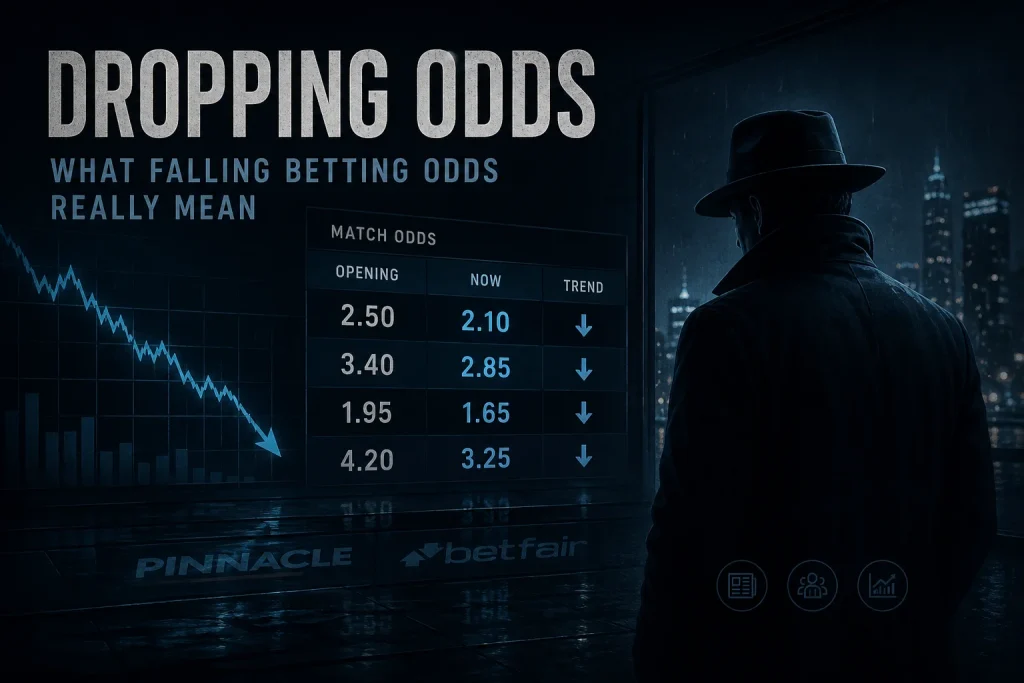
Sports betting markets move constantly. A team opens at 2.50, drops to 2.20 within hours, and closes at 1.95 before kickoff. For many bettors, these dropping odds look like hidden information, sharp money, or an opportunity to profit.
Sometimes they are. Sometimes they are not.
Understanding dropping odds is not about blindly chasing falling prices. It is about understanding why betting odds move, who may be moving them, and whether any value remains after the movement has already happened.
It is also worth noting that these price movements are linked to so-called dynamic odds, which form the basis of the business models of Asian bookmakers, Pinnacle, Betfair, and others
What Are Dropping Odds?
Dropping odds refer to a decrease in the betting price offered on a specific outcome.
For example, if a football team opens at odds of 2.50 and later moves to 2.10, the odds have dropped.
| Outcome | Opening Odds | Current Odds |
|---|---|---|
| Team A to win | 2.50 | 2.10 |
This movement suggests that the market now gives Team A a higher chance of winning than it did when the odds first opened.
Using implied probability:
- Odds of 2.50 imply a probability of 40%
- Odds of 2.10 imply a probability of 47.6%
However, this does not automatically mean that Team A is a good bet. The key question is not whether the odds dropped, but why they dropped.
Why Do Odds Drop?
Betting odds can fall for several reasons. Some movements are meaningful, while others are simply market noise.
1. Significant Money Entering the Market
One of the most important reasons for dropping odds is money entering the market on one side.
If respected or high-staking bettors place large wagers on a particular outcome, bookmakers may reduce the odds to limit exposure or reflect a more accurate probability.
This is often referred to as sharp money.
2. Team News and Injuries
Markets react quickly to new information. Odds may drop after news about:
- Injuries
- Suspensions
- Confirmed lineups
- Weather conditions
- Motivation factors
- Fixture congestion
- Travel problems
For example, if a key player is ruled out shortly before kickoff, the odds on the opposing team may shorten.
3. Public Betting Pressure
Popular teams and famous athletes often attract a large amount of recreational money.
Examples include major football clubs, national teams, NBA stars, or high-profile tennis players. In these cases, odds can fall because many casual bettors are backing the same side.
This kind of movement is not always smart movement. Public betting pressure can sometimes create poor prices rather than value.
4. Market Correction
Opening odds are not perfect. Asian bookmakers release early prices based on available information, models, and market expectations.
As more information becomes available and more bettors enter the market, prices may correct. A drop in odds can simply mean that the original price was too high.
5. Copying Sharp Markets
Many bookmakers monitor sharper markets and adjust their own odds accordingly.
If a respected bookmaker moves a price aggressively, other bookmakers may follow. This can create a chain reaction across the market.
Do Dropping Odds Mean a Bet Has Value?
Not necessarily.
This is one of the most common mistakes bettors make. They see that odds have dropped and assume the bet must be good.
But the value may have existed before the odds dropped, not after.
Example:
- Opening odds: 2.50
- True fair odds: 2.00
- Current odds after movement: 2.05
At 2.50, the bet may have offered strong value. At 2.05, most of that value may already be gone.
Professional bettors are usually trying to identify future price drops before they happen. They are not simply reacting to movements that have already occurred.
Sharp Money vs Public Money
To understand dropping odds properly, it helps to separate two types of market movement: sharp money and public money.
Public Money
Public money usually comes from recreational bettors. It is often emotional, narrative-driven, and focused on popular teams or favorites.
Public bettors may back a team because it is famous, in good form, or heavily discussed in the media.
Sharp Money
Sharp money usually comes from experienced bettors, syndicates, or model-based players. These bettors are price-sensitive and focus on value rather than popularity.
Sharp bettors may bet on unpopular outcomes, underdogs, lower leagues, or niche markets if they believe the price is wrong.
Why Bettors Watch Pinnacle
Pinnacle is often watched by experienced bettors because it is widely regarded as one of the sharper bookmakers in the betting industry.
Pinnacle is known for high limits, competitive margins, and efficient pricing. Because of this, odds movements at Pinnacle can be useful signals for bettors who monitor market direction.
However, a movement at Pinnacle does not automatically mean that a bet is profitable. It simply suggests that the market may have received meaningful information or respected betting activity.
Why Betfair Matters in Dropping Odds Analysis
Betfair Exchange is also important because it works differently from a traditional bookmaker.
On a betting exchange, users bet against each other rather than against the house. This can make exchange prices useful for reading market sentiment and liquidity.
Betfair can help bettors understand:
- Where the market is moving
- How much liquidity exists
- Whether a price move is supported by real money
- How quickly the market reacts to new information
As with Pinnacle, Betfair movements should be treated as signals, not guarantees.
How to Analyze Dropping Odds Without Software
You do not need expensive software to understand dropping odds. A structured process is often enough.
Step 1: Compare Opening Odds and Current Odds
Start by checking where the price opened and where it is now.
A move from 2.50 to 2.40 is different from a move from 2.50 to 1.95. The size of the movement matters.
Step 2: Look for News
Check whether there is a clear reason for the movement.
Look for injuries, suspensions, confirmed lineups, weather updates, tactical changes, or motivation factors.
Step 3: Compare Several Bookmakers
If only one bookmaker has shortened the odds, the movement may be isolated. If many bookmakers move at the same time, the market is probably reacting to broader information.
Step 4: Check the Timing
The timing of the drop matters.
- Early market movement may indicate sharp money or model-based betting
- Late movement may be linked to team news or confirmed lineups
- Sudden movement in small leagues may require extra caution
Step 5: Ask Whether Value Still Exists
This is the most important step.
Even if the odds dropped for a good reason, the price may no longer be attractive. A good bettor does not simply ask whether the odds moved. They ask whether the current price is still higher than the fair price.
Examples of Dropping Odds
Example 1: Legitimate Team News
A football team opens at 2.40. A few hours before kickoff, the opposing goalkeeper is ruled out. The odds drop to 2.05.
This movement may be logical because the market has adjusted to important team news.
Example 2: Public Overreaction
A famous favorite opens at 1.80 and drops to 1.55, despite no important news.
This may be caused by public betting pressure. In this case, the shorter price may actually be worse value.
Example 3: Sharp Movement in a Small League
A lower-league match opens with odds of 2.90 on one side. The price quickly drops to 2.30 with little public attention.
This could suggest informed money, but it requires deeper research. It should not be treated as automatic proof that the bet will win.
Common Mistakes Bettors Make With Dropping Odds
Assuming Dropping Odds Mean a Guaranteed Winner
No betting market movement guarantees an outcome. Odds reflect probabilities, not certainties.
Betting Too Late
Many bettors enter after the best price is gone. The value may have existed at 2.50, not at 2.05.
Ignoring Context
A price movement without context is not enough. Always ask what caused the odds to move.
Chasing Every Move
Not every drop matters. Some movements are small, random, or caused by recreational betting.
Confusing Probability With Value
An outcome can become more likely and still be a bad bet if the price has dropped too far.
Dropping Odds and Closing Line Value
One important concept connected to dropping odds is closing line value, often shortened to CLV.
Closing line value compares the odds you took with the final market price before the event starts.
Example:
- You bet at 2.30
- The closing odds are 2.00
In this case, you beat the closing line.
Many serious bettors care about CLV because consistently beating the closing price can suggest that their process is strong, even if short-term results vary.
Can You Make Money From Dropping Odds?
You do not make money from dropping odds alone.
You make money by identifying value before the market fully adjusts.
Dropping odds can help you understand where the market is moving, but they are only one piece of information. They should be combined with research, price comparison, bankroll management, and discipline.
How to Use Dropping Odds in Your Betting Process
A practical approach may look like this:
- Find a market where odds are moving
- Check whether the move is market-wide or isolated
- Look for the reason behind the movement
- Compare the current price with your own estimate of fair odds
- Only bet if value still exists
The goal is not to follow every price drop. The goal is to understand which drops are meaningful and which are not.
Final Thoughts on Dropping Odds
Dropping odds are one of the most interesting signals in sports betting. They can reflect sharp money, important news, market correction, or public overreaction.
But they should never be followed blindly.
The best bettors do not ask:
The odds dropped. Should I bet?
They ask:
Why did the odds drop, and is there still value at the current price?
That difference is crucial.
Dropping odds can be useful, but only when they are interpreted correctly. Treat them as a signal, not a shortcut.